
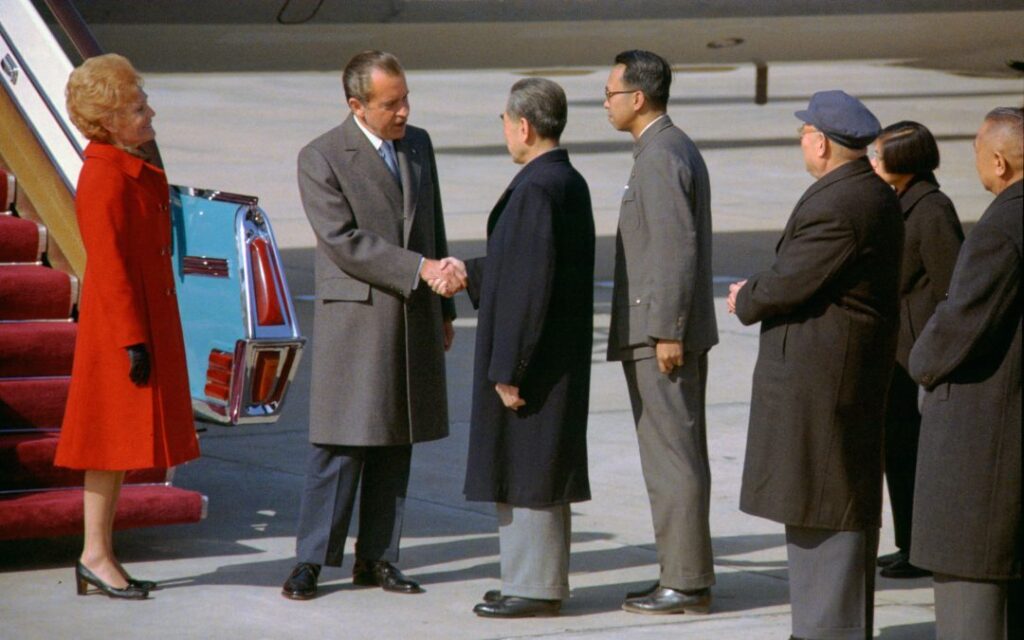
It all began in February 1969 with Nixon’s memo to Henry Kissinger. Three years later, the meeting at the highest level between China and the United States was held. Nixon was ecstatic.
On the home stretch
During Tricky Dicky’s stay, various meetings with Premier Zhou were planned. A meeting with Chairman Mao was not guaranteed due to his health condition. However, this was not of great importance for the success. Mao Zedong was constantly informed about every detail and approved everything. However, the Chairman’s health condition briefly improved, and Nixon was brought to him. The originally planned 15-minute meeting eventually turned into a full hour.
At this point, the content of the Shanghai Communique to be signed did not change significantly. Only the diplomats from both sides were still meticulously working on the wording. Every word was being fought over.
What was agreed upon during Nixon’s China trip in February 1972?
The main points of the Shanghai Communique were (quote):
“In view of the fundamental principles of the international relations, both sides declared that:
Progress toward the normalization of relations between China and the United States is in the interests of all countries.
Both sides wish to reduce the danger of international military conflict.
Neither should seek hegemony in the Asia-Pacific region, and each is opposed to efforts by any other country or group of countries to establish such hegemony.
The United States side declared: The United States acknowledges that all Chinese on either side of the Taiwan Strait maintain there is but one China and that Taiwan is a part of China. The United States Government does not challenge that position. It reaffirms its interest in a peaceful settlement of the Taiwan question by the Chinese themselves. With this prospect in mind, it affirms the ultimate objective of the withdrawal of all U.S. forces and military installations from Taiwan.” (End quote)
The lines of this blog series only inadequately reflect the various facets of the probably more than 50-hour-long conversations. Hopefully, it has nevertheless been possible to draw a somewhat clear picture. The important question now is where the parallels to the current situation, to today’s US-China conflict, lie, how we can learn from the past, and how we can use this knowledge to avoid a possible catastrophic war between the United States and the People’s Republic of China. Some thoughts on this can be found in the next blog post: “The Week that Changed the World V/VI“
Other blog posts in this series:
“The Week that Changed the World I/VI“
“The Week that Changed the World II/VI.“
“The Week that Changed the World III/VI”
“The Week that Changed the World VI/VI“
Below you can find my English YouTube video on the week that changed the world: